
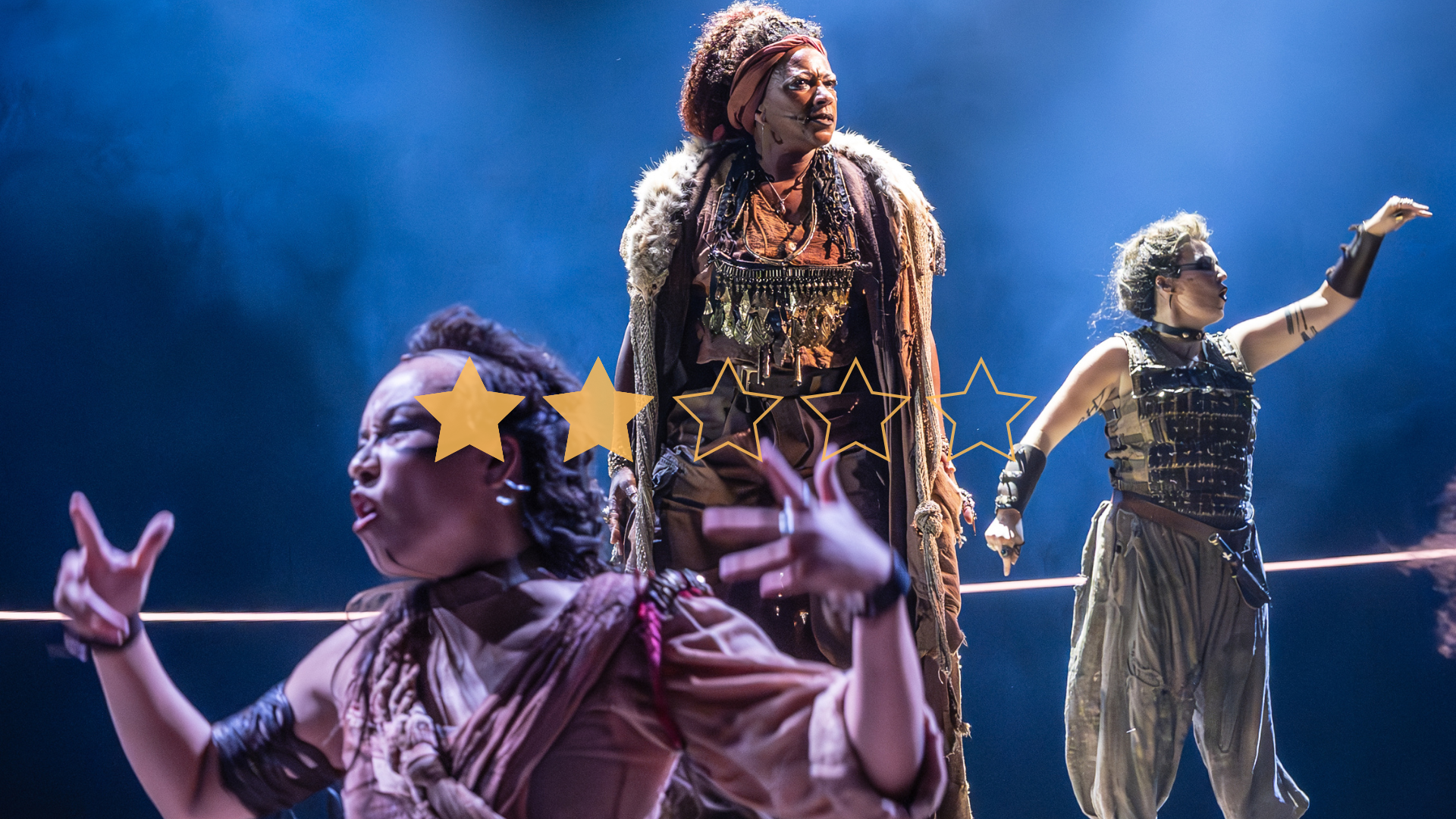
★★☆☆☆
Nima Taleghani’s Bacchae begins with a haunting, echoing whistle. The theatre falls dark, before a giant horse’s head, dripping with blood, appears floating in the centre of the stage. There’s an immediate electric energy; the two guards who see the horse are horrified, recognising it as the queen’s. She must be dead, they surmise—and run to tell Pentheus (James McArdle), the queen’s son, of the awful news.
This is the most intense point of the play. The tension is swiftly diffused by Vida (Clare Perkins), who steps forward and mocks the pair for their dramatics. She sets the tone for the rest of the show, one that’s self-referential, lighthearted and somewhat underwhelming.
In terms of staging, this is a stunning production. Stacked rotating platforms, evoke the forest setting, while a giant wardrobe and imposing pillar swiftly change the scene to Pentheus’ grand palace. Impactful lighting choices enhance the action, illuminating trails of blood and proving Dionysus’ godliness, but aren’t overused. It’s greatly effective and well-considered, elevating the piece without distracting from the narrative. Unfortunately, this Bacchae’s style is far more than its substance.
Taleghani’s interpretation leaves behind many of the intricacies and specificities of the original play, favouring more of-the-moment emphasis on migration, misogyny and governmental tyranny. Simultaneously perennial and timely issues, but not ones that feel particularly well-served by this narrative vehicle. The play races across ideas without ever offering a new or interesting perspective on them, leaving a trail of surface-level comments and half-examined concepts. The Bacchae are divided in their approach to bringing about change, split in their opinions on violent action; Pentheus muses on whether he has failed in his role as a man, and laments the lost innocence of his youth; Dionysus campaigns for the Bacchae, representing foreigners, to be able to live in Thebes.
These assertions that gender roles are oppressive and that racism is bad, without any sharp critiques to accompany them, are not particularly interesting to watch. Perhaps if it were angled towards a younger audience the play would be an educational if bland introduction to some of these points, but various bawdy jokes mark it as firmly adult-oriented. The result is a strange combination, a play that tries to shock with its humour but holds back in its content. The characters themselves never feel as dangerous or transgressive as they purport themselves to be, their most outrageous actions coming in the form of lurid sex jokes and vague references to political overthrows and violence.
In this iteration, the Bacchae go from being fearsome, lawless followers of a hedonistic god to an oppressed religious-slash-militant group, designated as terrorists by governments and left to roam the world without a real home. If other elements of the story were altered, perhaps this could work. As it stands, this muddles their motivations and purpose.
Dionysus, too, never feels scary, even when his godly side and need for vengeance is at the fore. Ukweli Roach’s performance leans into the humour, and to good effect, but there’s little depth to the character. The overall inconsistency in tone that makes it difficult to really get invested in the plot. The final tragedy doesn’t have much emotional potency after all the jokes, and while the song and dance moments work well, they could do with being a little less controlled.
Various self-aware references to the play taking place at the National and the audience it’s facing feel slightly clunky. In its final moments, Bacchae decides that it’s a story about theatre, and its role in society. A rather clunky metatextual message from new director Indhu Rubasingham, but one that does set expectations high for The National’s next few years.
Bacchae plays in the Olivier Theatre until 1 November.
Words by Lucy Carter
Support The Indiependent
We’re trying to raise £200 a month to help cover our operational costs. This includes our ‘Writer of the Month’ awards, where we recognise the amazing work produced by our contributor team. If you’ve enjoyed reading our site, we’d really appreciate it if you could donate to The Indiependent. Whether you can give £1 or £10, you’d be making a huge difference to our small team.