
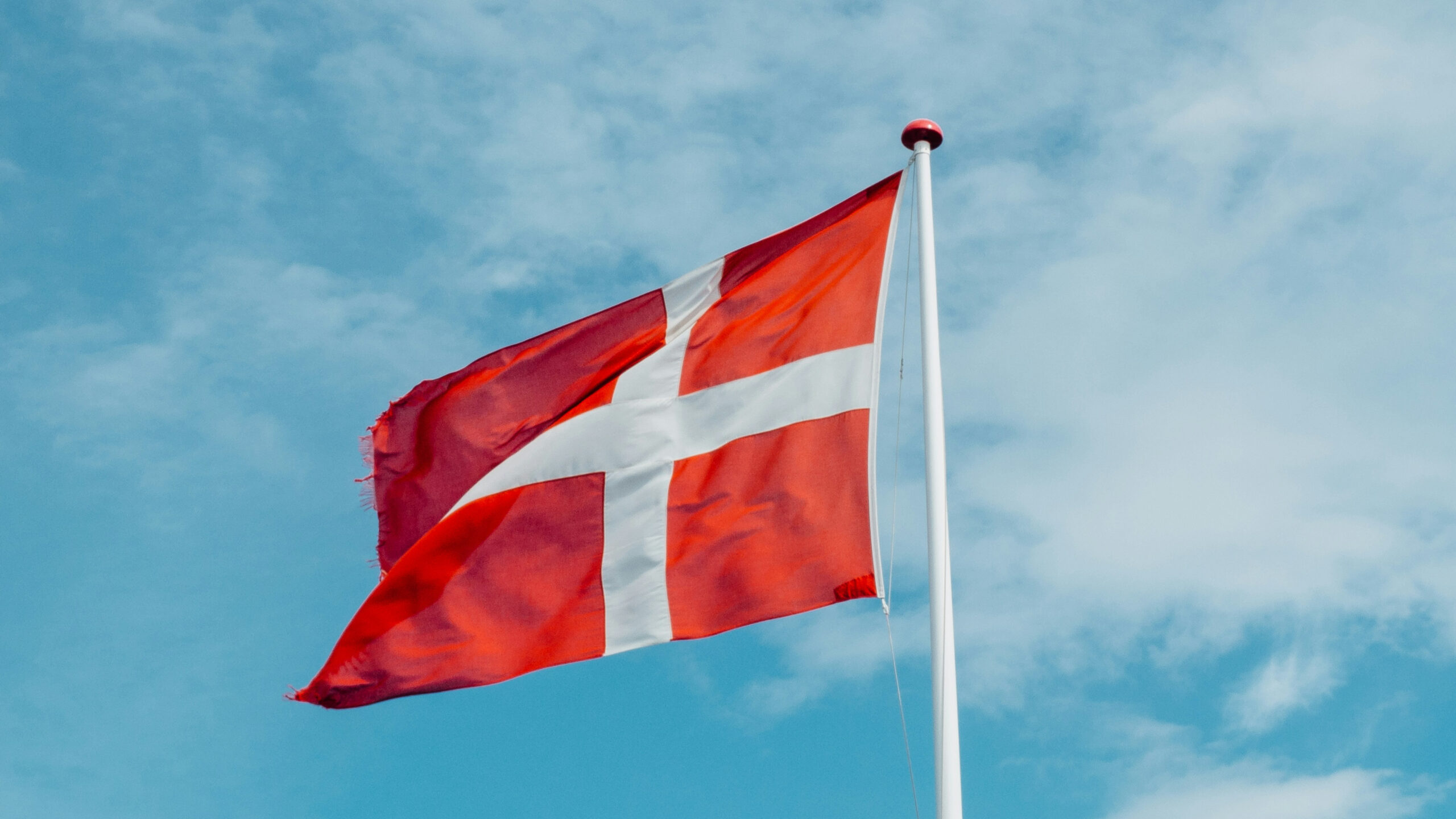
Denmark consistently ranks among the world’s “happiest countries,” while also being one of the most patriotic. The World Population Review scores Denmark’s patriotism at 13% – the same as the UK. Denmark’s red-and-white flag, the Dannebrog, is everywhere—flown in gardens, town squares, and boats—and fiercely protected as one of the only flags permitted to fly from a flagpole. It represents not just a symbol of statehood, but an everyday pride in being Danish.
Yet this patriotism is softened by hygge, the Danish word for “cosy comfort,” which is woven into daily life. Smørrebrød stands, pølser vendors, rye bread bakeries, and cafés serving cardamom buns are as much a part of the streets as they are the cupboards of Danish homes. Alongside these cultural comforts, the Dannebrog stands peacefully and purposefully—an emblem not of division but of belonging.
The UK is no stranger to flag-waving, but the symbolism is markedly different. When the Lionesses won the Euro 2025 tournament this summer, the St George’s Cross flew proudly across the country in celebration. But while the victory was in July, the English flag remains prominent today, its resurgence tied not only to football but to politics.
The recent Raise the Colours campaign, promoted as a celebration of national pride, is closely linked with anti-immigration protests. This came after a summer in which immigration dominated headlines, with Reform UK leader Nigel Farage boasting of 150,000 new party members and pledging that “600,000 asylum seekers could be deported in the first parliament of a Reform UK government” (despite there only being 224,700 pending asylum cases, including appeals, in the UK, as of June 2025). In this context, the English flag is not just a cultural marker, but a political tool that stokes strong emotive responses. Council workers have even had people try to pull ladders out from underneath them when it was suspected they were trying to remove flags from lamp posts.
While in Denmark the Dannebrog is bound up with culture, history, and companionship, the St George’s Cross—and, to a lesser extent, the Union Jack—has long been tainted by far-right associations. It is too often claimed by nationalist movements that exclude rather than unite, more prominently so than the Welsh, Scottish or Northern Irish flags (although to say that none of those are used by anti-immigration movements would be untrue).
For more cases in point, you only need to look at the merchandise of groups such as the British Freedom Store, which sells badges branded with slogans like “English and proud,” Christian nationalist imagery, and “defiance not compliance” in reference to “Covid-1984.” The flag here is not a symbol of shared community, but a personal banner of exclusion and rampant individuality. One person may wave it to promote racist policies, another to assert ownership of English identity and the authority to decide who ‘belongs.’
By contrast, the Dannebrog stands for community. It represents fællesspisning (communal dining), the casual trust of leaving your bike unlocked, and the cultural glue that binds people together. It signals inclusion, trust, and heritage—a meaning the English flag has drifted away from.
The Lionesses’ triumph briefly offered a different vision. The flag was draped across shoulders in celebration of women’s football and national success rather than wielded as a weapon of division. For a moment, it seemed possible that the St George’s Cross could glow with its own kind of hygge. Yet that hope was quickly overshadowed by the resurgence of rhetoric promoting a ‘red and white’ England that sidelines minority communities. In Denmark, patriotism centres on shared community; in the UK, it too often signals exclusion.
And yet the structural differences between the two countries are smaller than one might assume. The UK’s population is around eleven-and-a-half times larger than Denmark’s, and the share of immigrants is nearly the same—16.8% in the UK versus 16.3% in Denmark. But the contrast in hostility is staggering. In 2021, Denmark’s National Police reported 569 hate crimes, 312 of them racially motivated. The UK, by comparison, recorded 109,843 racially aggravated offences in the same year. Adjusted for population size, and according to these statistics, there is thirty times as much violence against people of colour in the UK compared to Denmark.
This does not mean Denmark is free of exclusionary policies. In 2025, the Danish government banned face coverings, and in 2018, its government debated outlawing circumcision for boys under 18. These laws disproportionately affect religious communities, but they coexist with a social fabric where religion and difference are otherwise freely expressed.
What this comparison reveals is that in the UK, differences are increasingly treated as divisions, and the flag has become the banner of that fracture. Its meaning has shifted from ‘us’ to ‘I’ and has too long been used as a symbol claimed by individuals to rally against what they see as restrictions on freedom, and to define who is welcome and who is excluded. Patriotism in England should be something we hold pride in instead of conflating it with racism and hostility.
Denmark may not match England on the football pitch, but the country has much to teach us about patriotism. Demonstrating how pride in one’s nation can strengthen rather than divide, and how a flag can be a beacon of community rather than a weapon of exclusion.
Words by Myfanwy Fleming-Jones
Support The Indiependent
We’re trying to raise £200 a month to help cover our operational costs. This includes our ‘Writer of the Month’ awards, where we recognise the amazing work produced by our contributor team. If you’ve enjoyed reading our site, we’d really appreciate it if you could donate to The Indiependent. Whether you can give £1 or £10, you’d be making a huge difference to our small team.