
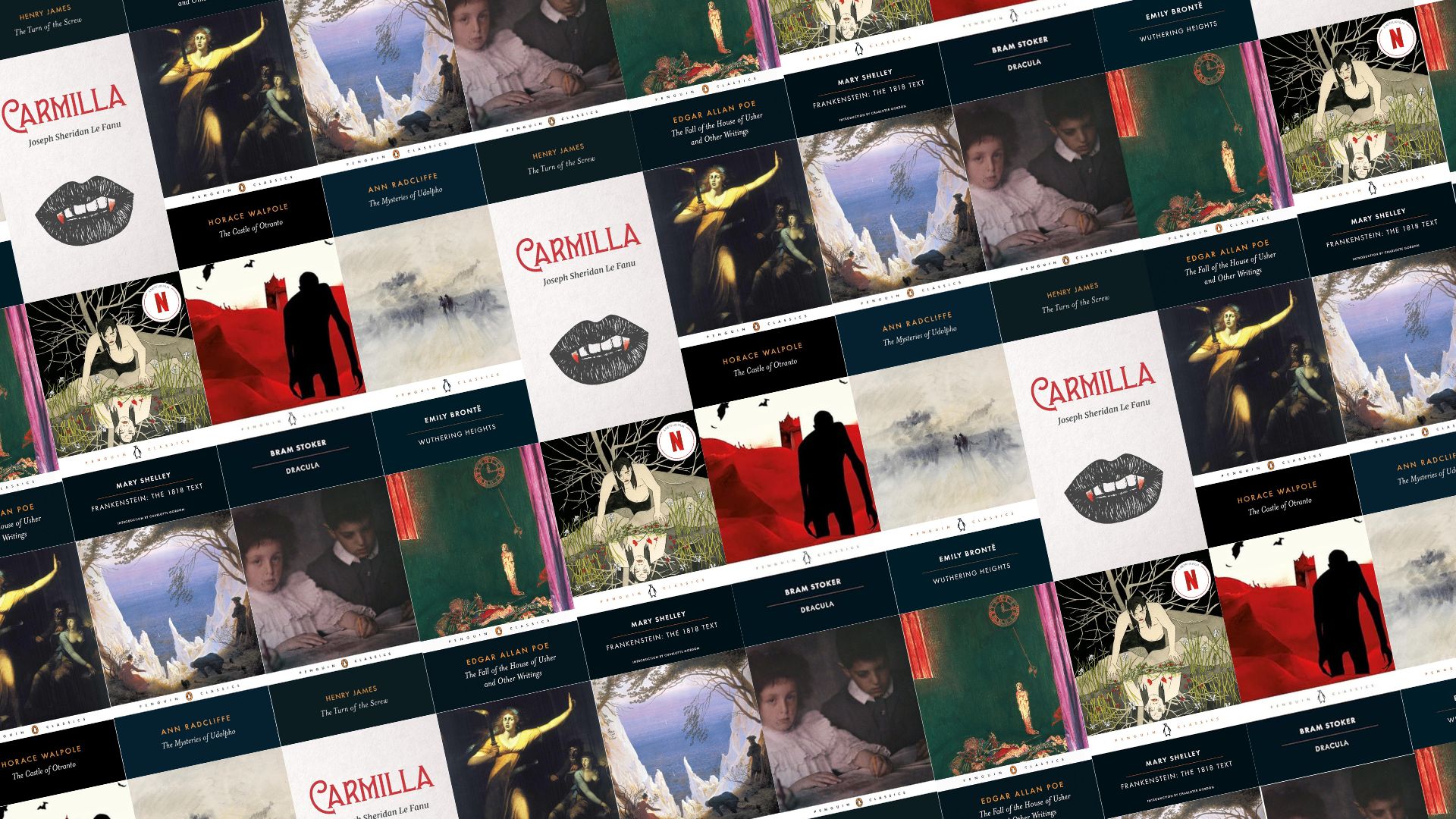
When the first trailer for Emerald Fennell’s new adaptation of Wuthering Heights earlier this year, it sparked major controversy among fans of Emily Brontë’s Gothic classic—for everything from its casting and costumes, to its soundtrack and subject matter. We are undoubtedly experiencing a Gothic book-to-screen Renaissance right now (Mike Flanagan I’m looking at you), though in some cases, maybe we should question why directors are choosing to adapt Gothic classics, arguably to the detriment of the original literature and its legacy.
Starring Margot Robbie and Jacob Elordi, who are deemed by some as having ‘iPhone faces’ too modern for historical films, the Wuthering Heights trailer sent the internet into outrage over its polarising spin on such a beloved book. Not only is the teaser soundtracked to an orchestral rendition of Charli XCX’s recent hit ‘Everything is romantic’, it is also interspersed with some really steamy scenes that certainly weren’t penned by Brontë in 1847. While the film’s erotic themes veer away from Wuthering Heights, which is much more concerned with romantic obsession and revenge, it must be of importance that the film’s poster places quotation marks around the title: “Wuthering Heights”. Could it be that the film itself will be hyperaware of its diversion from the literary canon, or perhaps it will be a pastiche of the Gothic ‘romances’ of the nineteenth century? Considering Fennell’s penchant for being subversive and boundary-pushing in her other films, this doesn’t seem too implausible.
Even the film’s casting director, Kharmel Cochrane, responded to criticism over Fennell’s flimsy interpretation of the source material, telling Deadline that “there’s definitely going to be some English lit fans that are not going to be happy”. Fennell also received backlash over her decision to ask Elordi to play Heathcliff, a character whose ethnicity is famously ambiguous. Although Brontë only offers vague descriptions of Heathcliff’s ethnicity, his racial and social ‘othering’ is central to the hostility he faces from wider society. I stand amongst those fans who feel that casting a white actor in this role erodes the nuances of race and social class that permeate the novel’s plot. Eroticising the narrative is one thing, but the ethnicity of a character should always be a vital sticking point in book-to-screen adaptations. The novel’s preoccupation with ‘otherness’ also aligns closely with the nature of the Gothic genre, and is something Emily Brontë would likely have recognised on a personal level in her father’s decision to change the family’s original Irish surname, ‘Brunty’.
Slated for a Valentine’s Day 2026 release, speculation on how Fennell’s adaptation will fare with devout Brontë fans is sure to continue for the next few months, and the abundance of cultural commentary around it will certainly be enough to get audiences to cinemas. I expect it will definitely have a super viral moment online too, taking the reins from its depraved and raunchy predecessor, Saltburn (2023) – early test screenings have received some mixed reviews, with one viewer describing it as “aggressively provocative”.
Fennell is certainly not the only contemporary director sinking her teeth into nineteenth century Gothic literature. Robert Eggers is already an established presence in the Gothic horror genre, famed for The Witch (2016) and The Lighthouse (2019).
What stands out about Eggers’ Nosferatu (2024), however, is that it is a remake of 1922’s Nosferatu: A Symphony of Horror – in itself a loose, unauthorised retelling of Bram Stoker’s Dracula. While the original story has seen over 200 screen adaptations, this adaptation of an adaptation adds an extra layer of complexity to Dracula’s cultural legacy.
Although Nosferatu’s narrative mostly remains faithful to the original plot and character tropes, the ending of the film strongly diverges from Dracula’s. Another major alteration is that the story is told from Ellen’s perspective (Lily-Rose Depp) rather than her husband Thomas Hutter (Nicholas Hoult). By giving a voice to a female character who was merely a side character in the original novel (Ellen is inspired by Mina Harker), Eggers appeals to contemporary viewers who are eager to see complex, multifaceted women on screen.
Eggers’ approach can also be read in light of Dracula’s vampiric predecessor, Sheridan Le Fanu’s Carmilla (1872), which specifically foregrounds a female perspective, indicating how Stoker’s solely male narration was a conscious choice rather than a necessity of the Gothic genre. The overwhelming cultural perceptions of vampire stories are cumulative, shaped through androcentric retellings that have gradually obscured earlier, more diverse vampire narratives such as Carmilla.
Despite being a looser retelling of Stoker’s story, the critical and commercial success of Nosferatu is an obvious indicator of the public appetite for Gothic stories with moral complexities and unnerving atmospheres.
It is also of note that contemporary filmmakers seem to consistently gravitate towards slightly later Gothic novels from the nineteenth century, rather than the genre’s earlier foundations in works like Walpole’s The Castle of Otranto (1764), or Radcliffe’s The Mysteries of Udolpho (1794). These earlier novels rarely enter the sphere of popular adaptation, which is suggestive of our cultural preference for the more modern, psychologically driven stories that emerged later in the genre’s development.
Condensing a complex and lengthy piece of nineteenth-century prose into a standard two-hour runtime can be challenging. Films are required to edit out a significantly large portion of their literary contents, simply because long narratives are impossible to encompass within such slim time restraints. It is inevitable then that any Gothic text may lose some of its original intricacies, often drawing ire from diehard fans.
This is not to say that film is the only method of transferring literary material to the screen; look no further than Mike Flanagan’s various successful Netflix series. Flanagan has adapted three Gothic classics so far: Shirley Jackson’s The Haunting of Hill House, Edgar Allan Poe’s The Fall of The House of Usher, and Henry James’ The Turn of the Screw (renamed The Haunting of Bly Manor for Netflix). Each of these shows are around 10 hours long, allowing for much more scope and detail compared to film adaptations. Interestingly though, Flanagan’s vision for his shows is often radically unfaithful to the original material he takes inspiration from, whether that be in the time period, characters, or even major plot points.
This highlights the distinct tension between audiences wanting to see utterly faithful adaptations that unwaveringly stick to the narrative and themes of the original literature, and those who are interested in seeing how Gothic classics can be reimagined in the twenty-first century, forming a new legacy for these beloved authors and their stories. The reception to Guillermo del Toro’s recent reanimation of Mary Shelley’s Frankenstein (2025) illustrates how playing fast and loose with narrative details can divide audiences. One thing is certain, however: as long as audiences remain hungry for more, the Gothic book-to-screen Renaissance shows no sign of disappearing, even at the risk of Brontë turning in her grave.
May the surge of Gothic adaptations continue!
Words by Freya Parker
Want more Books content from The Indiependent? Click here
Support The Indiependent
We’re trying to raise £200 a month to help cover our operational costs. This includes our ‘Writer of the Month’ awards, where we recognise the amazing work produced by our contributor team. If you’ve enjoyed reading our site, we’d really appreciate it if you could donate to The Indiependent. Whether you can give £1 or £10, you’d be making a huge difference to our small team.