
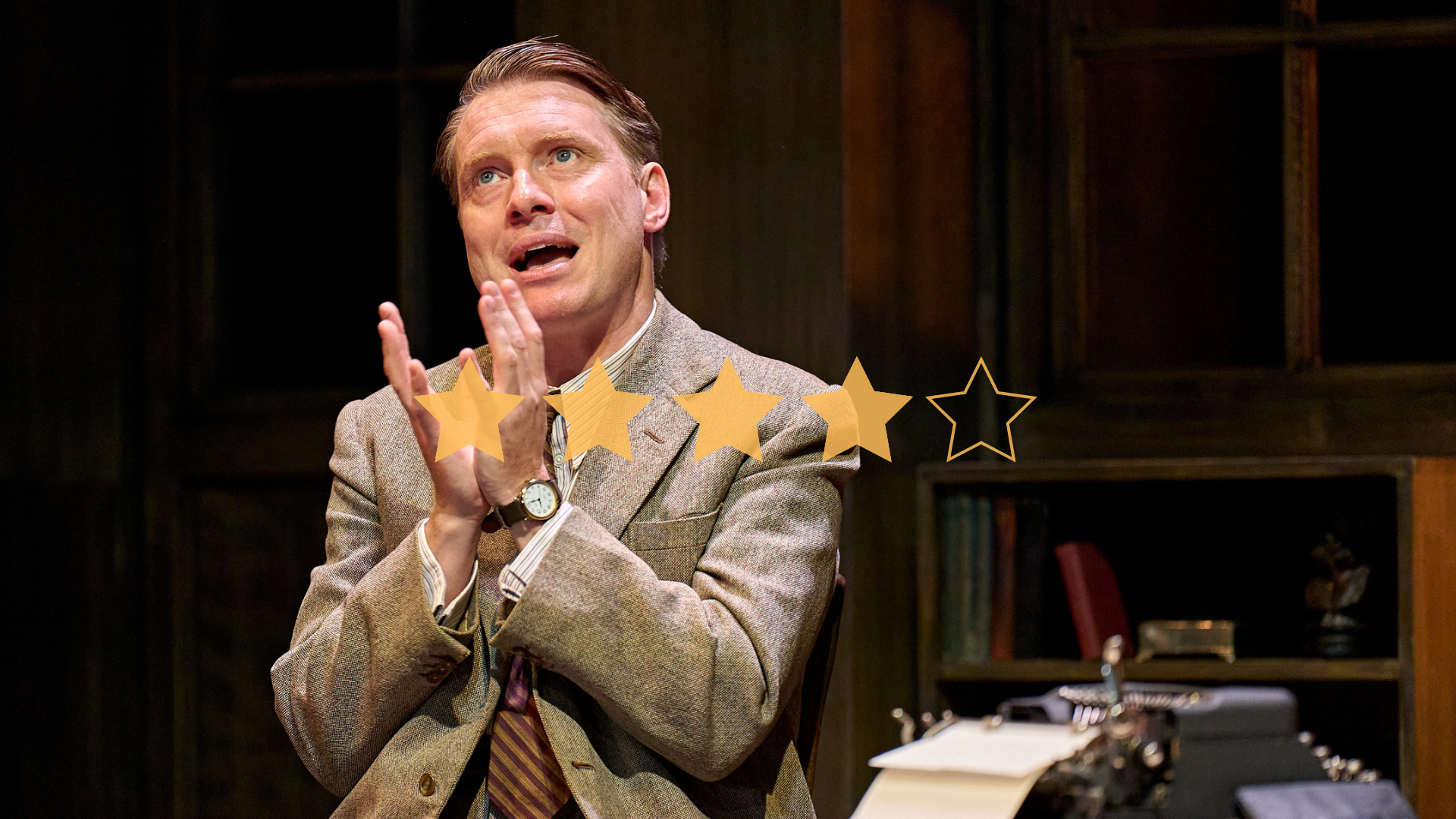
★★★★
It was not only his work on breaking the enigma code that made Alan Turing a household name, but unjust laws that played a hand in his life, and his untimely death. Known for his unwavering sense of staying true to himself, Turing was a man of integrity ultimately convicted for “homosexual acts”. Jesse Jones’s production of Breaking the Code, originally written by Hugh Whitemore in 1986, brings Turing’s story back into the limelight at Liverpool’s Playhouse Theatre. It reimagines the enigmatic mathematician and scientist with profound gravity.
The performance begins with the burglary of Turing’s (Mark Edel-Hunt) house in Manchester—it is the 1950s and it is raining. The audience meet a Turing who is hiding in plain sight—no one knows of his contributions to the war effort, and few are discussing sexuality out in the open. As the present unfolds, so does the past. Slick scene changes, and effortlessly compelling acting from Edel-Hunt lead us through Turing’s life and the people who influence him throughout.
Edel-Hunt’s Turing is masterful. His performance is composed and yet unravel—it displays Turing at his most vulnerable and his most passionate—and everything in between. Through subtle changes in lighting and poise, Turing flits through time periods and grows into the mathematician he dreams of being since a child. Jones directs mesmerising theatre, transporting you around Turing’s life with grace and ease. There is not so much of the heady heights of breaking the enigma code detailed in the performance, but more emphasis placed on Turing himself and the man behind the discoveries.
Sharp and witty writing brings Turing to life, whether it’s a monologue about the maths of machines or his platonic love for colleague Pat Green (played by Carla Harrison-Hodge and based on real-life Joan Clarke). Alongside him, as his mother, Susie Trayling delivers a strong performance, rooting the ideas of the times in the show. Building on the relationships in Turing’s life gives an indication of his moral sense of the right and wrong, and how he values honesty above all—in the end, to his detriment. Some relationships deserve a little more fleshing out and feel unfairly limited in scope. Scenes with Turing’s childhood friend Christopher (Joseph Edwards), whilst charmingly entertaining, fall short and feel stunted given that many suggest he played a large part in Turing’s life.
Jones gives a final twist in the tale of Breaking the Code, almost a quick stab at bringing Turing into today’s world through an epilogue written by Neil Bartlett. Launched out of the ‘50s and into an iPhone wielding age, the audience are presented with a handy summary of Turing’s life that might have felt a little less on the nose had we just been left to mull over the performance by ourselves. A sweeping statement on current LGBTQ+ rights in the UK appears to suggest all is well with the state of affairs, and just look at how far we have come since Turing’s time. It feels perhaps a little hasty and loses some of the emotional clout garnered by Edel-Hunt into the second act.
It is difficult to wrap up such an impressive man’s life into one production, and though occasional nuance is lost, Breaking the Code is a charming and devastating look at Turing. It is a captivating performance that deserves audiences far and wide.
Breaking the Code is currently touring the UK, and will make its final stop at HOME, Manchester from 28 October to 1 November.
Words by Hannah Goldswain
Support The Indiependent
We’re trying to raise £200 a month to help cover our operational costs. This includes our ‘Writer of the Month’ awards, where we recognise the amazing work produced by our contributor team. If you’ve enjoyed reading our site, we’d really appreciate it if you could donate to The Indiependent. Whether you can give £1 or £10, you’d be making a huge difference to our small team.