
What impact does a legacy of visual misogyny have on society? Karen Page asked the question with her recent immersive installation, Wallpaper Of Our Culture, leaving the viewer nowhere else to hide.
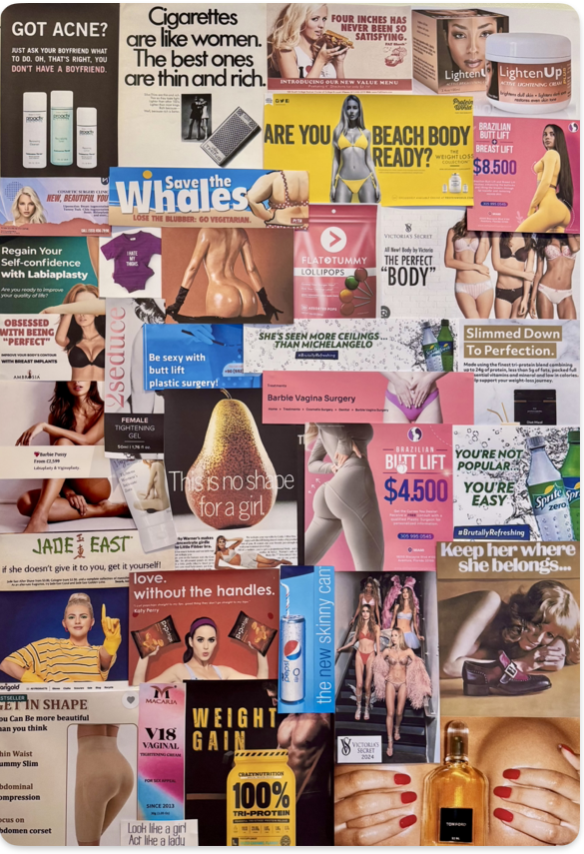
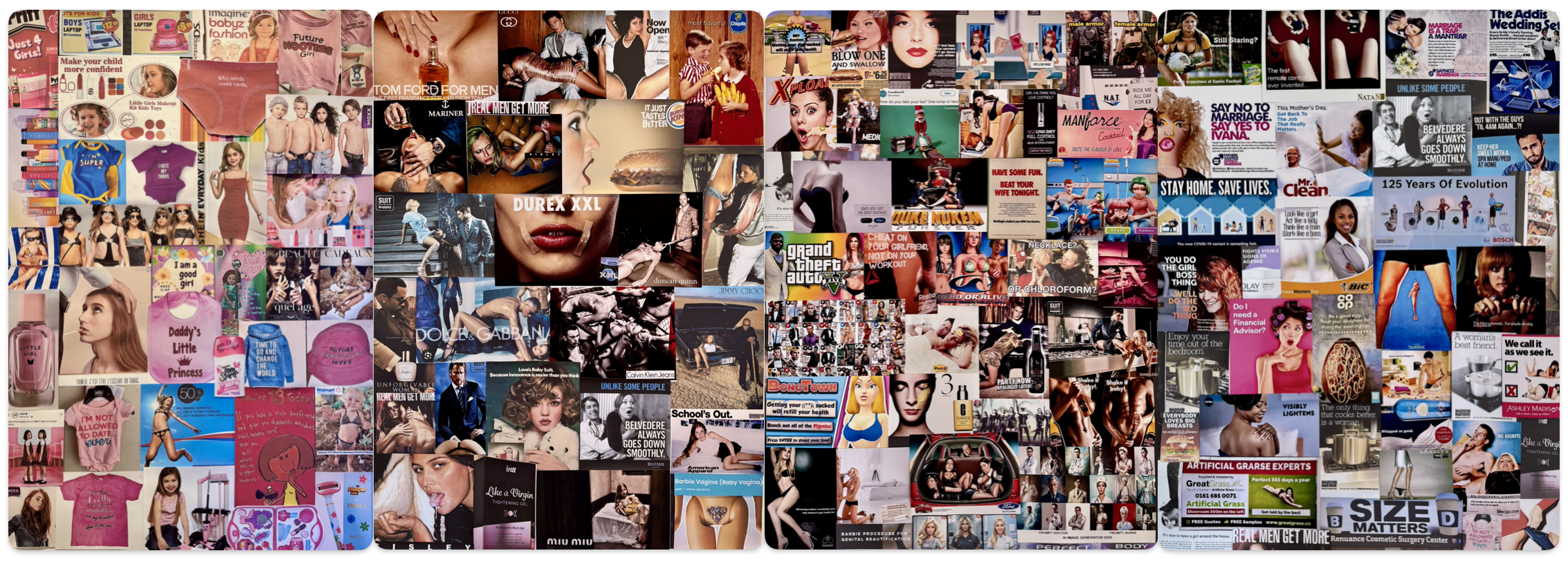
Located in the heart of Bethnal Green, Page transformed her studio into a kaleidoscope of glossy magazines and underground grunge. The space showcased decades of harmful advertising which women and men of all generations have been exposed to at some point in their lives. Page created collages of adverts that she found trawling the internet, research papers, and car boot sales.
Page became interested in the evolution of the images that she was collecting, and was horrified at the progression from innocent, almost laughable, sketches of the 1960s to the influx of darker, graphic images at the turn of the millennium. Household names, such as Calvin Klein, Burger King, and Ford are littered throughout the scene in nearly every major industry, demonstrating the breadth of the problem which she is addressing.
From gendered glue sticks, children’s clothes, and stationery items, to shocking images of femicide, sexual violence and degradation, Page presents a striking time capsule of society’s most unsavoury episodes.
Personal Archive, Collective Burden
Page started to create archives of the images while at the Royal College of Art. She began thinking about the advertising that she had been exposed to which had a long-lasting impact on her body-image and self-worth. “Those messages go very deep. They are imprinted somewhere in my hard drive,” she told me in an interview. After discovering that an archive did not already exist, she decided to create her own, documenting what she describes as a “generational burden.”
After curating her archive, Page layered the images across every surface of her space, engulfing the room in the misogyny she experienced, leaving the viewer powerless but to look on. For men, acknowledging the true impact of these images for the first time, it is a shocking experience. The room feels tight and claustrophobic. Despite electric yellows and inviting, neon reds bursting across the interior, a closer examination reveals a frightening revelation into a culture that profits from self-hatred and inadequacy.
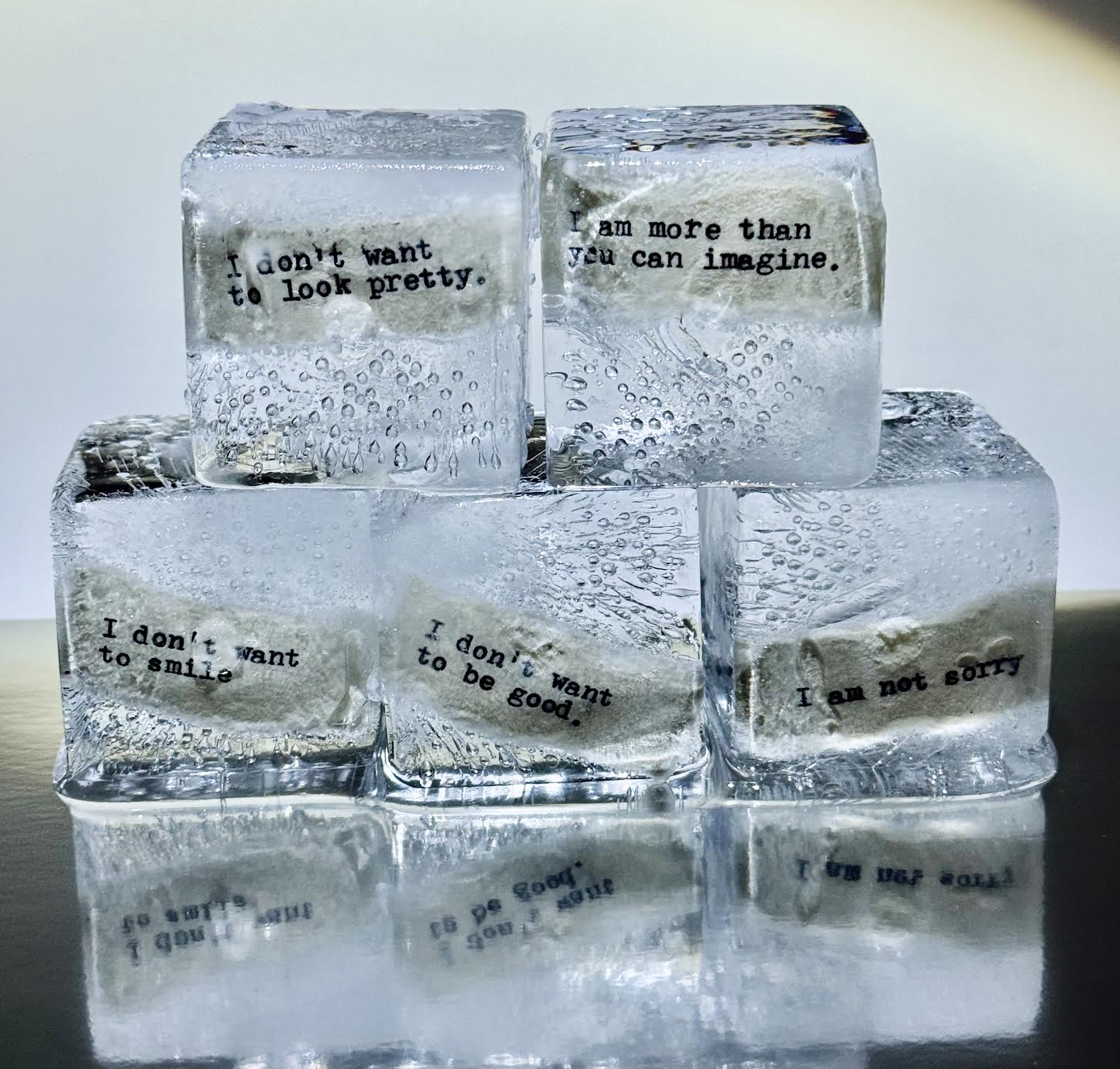
Acting as a companion to her archives, Page exhibited her collection titled What I Can’t Say, visualising the impact that the advertisements had on her. She wrote messages on an old typewriter, froze them into blocks of ice, and photographed them. “I thought about how it’s taken me a long time to free myself of what I feel I should do,” she added. As the ice slowly melts, her voice returns to her.
Looking Forward With Caution and Hope
The exhibition draws no conclusions, but rather highlights a repeated pattern of messaging which has prevailed in society for countless generations. In the age of Andrew Tate and red-pilling, she remains hopeful that progress can still be made. “There’s still another side, a real awareness and a real desire to change, and desire for equality and education,” she said.
However, this progress is threatened by advertising in the digital age. Page is deeply disturbed by adverts that target children in online mobile games, promoting domestic violence and other harmful behaviour or attitudes towards women. No longer are adverts confined to print media or bus stops, they are readily available in our pockets at all times.
As artificial intelligence models develop, Page wishes to explore how they learn from a database of abundant, discriminatory material to create images of its own. She envisions that artificial intelligence will replicate the society which built it, leading to a proliferation of advertising that has damaged so many people.
“Nothing is ever all good or all bad”, she comments, “I don’t believe anything in life is like that”. In an age where mobile phones are a necessity, rather than a luxury, Page believes that we must develop with technology, and scrutinise the harm which has preceded it to protect the next generation of boys and girls.
Her next collection will examine the amount of messages a young person will receive online in a month; how the mystical algorithm deciphers their activity to promote products to them, and what impact this is having on today’s generation of children.
Wallpaper Of Our Culture is an ambitious piece, weaving together the threads of a dysfunctional society. Page demonstrates that misogyny in the mainstream is not a relic of the past, but rather a baton that generations of women have had no choice but to carry their entire lives.
Page’s work is not stuck in the past; it is not intended to act solely as a social history. Instead, she looks to the future, and asks how we can do better for all of society.
Karen Page’s Wallpaper Of Our Culture was on display from 16 June – 22 June 2025 on Bethnal Green Road, free to the public. Her other works can be found at her website.
Interview by Jenson Davenport with Karen Page on 2 July 2025.
Words by Jenson Davenport
Support The Indiependent
We’re trying to raise £200 a month to help cover our operational costs. This includes our ‘Writer of the Month’ awards, where we recognise the amazing work produced by our contributor team. If you’ve enjoyed reading our site, we’d really appreciate it if you could donate to The Indiependent. Whether you can give £1 or £10, you’d be making a huge difference to our small team.